Two Quotes. A Gap of Twenty-Seven Thousand Rupees. What Is the Difference?
Priya had done what most parents do — she had called several clinics before deciding. The quotes she received ranged from Rs. 8,000 to Rs. 35,000. The word 'assessment' appeared in the description of every one. She called me with a simple, reasonable question: 'What am I actually comparing? What is the Rs. 35,000 assessment doing that the Rs. 8,000 one is not?'
This blog is the answer — not just about cost, but about what question each type of assessment can and cannot answer, and how to know which one your child actually needs.
The Assessment Spectrum — Four Types
Type 1 — Developmental Screening
A brief, standardised tool — typically thirty to sixty minutes — that identifies children who may be at risk for developmental delays or specific conditions. Often used by paediatricians and developmental specialists as a first-level filter. Produces a flag — 'concern present' or 'no concern' — not a diagnosis. Reports from screening assessments are not accepted by CBSE or schools for accommodation purposes. If your child has been screened at school and flagged as at risk, the next step is a full assessment with a qualified psychologist.
Type 2 — Diagnostic-Only Assessment
An assessment focused on determining whether a specific condition is present — autism, ADHD, or a specific learning disability. Uses standardised diagnostic tools for the specific condition being assessed. Typically two to three sessions. Produces a diagnostic conclusion. Does not include: the child's full cognitive profile, the specific cognitive strengths and weaknesses driving the difficulties, the full range of co-occurring conditions, or detailed individually tailored recommendations for home and school.
Type 3 — Comprehensive Psychoeducational Assessment (Gold Standard)
The gold standard for children with learning difficulties, neurodevelopmental conditions, or academic underperformance. A multi-session, multi-informant assessment covering cognitive ability, specific processing skills, academic achievement, behavioural and emotional functioning, and the child's specific diagnostic profile.
What it can tell you:
Whether a specific diagnosis (autism, ADHD, dyslexia, dyscalculia, or other) is present
The child's full cognitive profile — intellectual strengths and weaknesses across multiple domains
The specific processing difficulties driving their academic or behavioural challenges
Co-occurring conditions that need to be addressed alongside the primary diagnosis
Specific, individually tailored recommendations for school accommodations, therapy, home support, and examination applications
Reports produced:
Accepted by CBSE, ICSE, and state boards for accommodation applications, by schools for IEP and accommodation requests, and for disability certification processes. This is the assessment type most children with autism, ADHD, dyslexia, or significant academic difficulties actually need.
Type 4 — Specialised Assessment
A focused assessment in a specific domain — speech and language, OT sensory, neuropsychological. Typically delivered by the relevant specialist as part of a multidisciplinary evaluation, or when a specific domain question needs detailed assessment beyond what a general comprehensive assessment provides.
What Makes a Comprehensive Assessment 'Comprehensive'
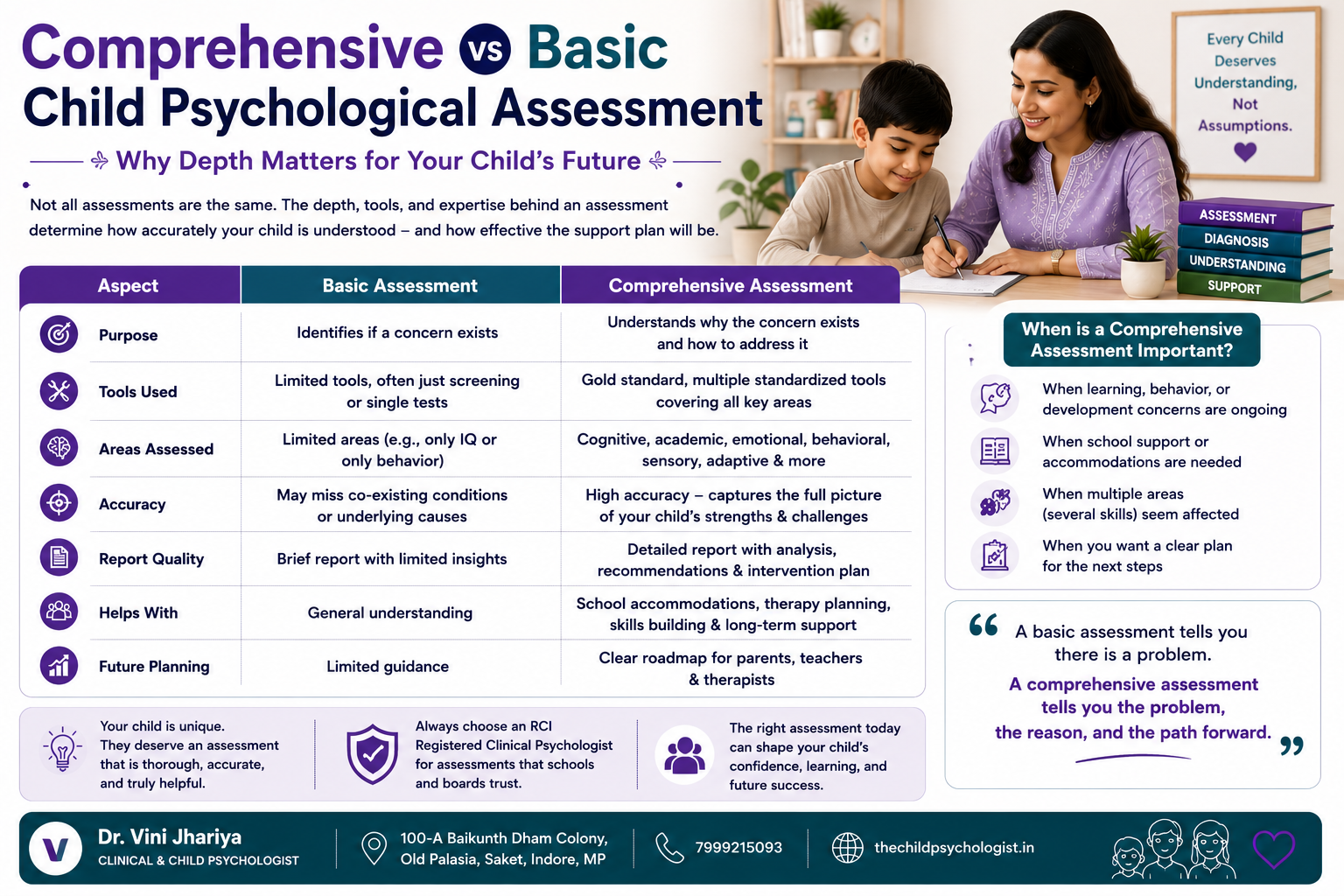
The comprehensiveness of an assessment is not about length — it is about the breadth of domains covered and the quality of integration across those domains. A genuinely comprehensive assessment covers:
Cognitive ability — verbal comprehension, fluid reasoning, working memory, and processing speed (WISC-V or equivalent)
Specific processing skills — phonological processing, rapid automatised naming, visual-motor integration, language processing
Academic achievement — reading, spelling, written expression, and mathematics assessed against standardised norms
Attention and executive function — measured through direct testing and standardised rating scales (Conners, BRIEF, Vanderbilt) completed by parents and teachers
Behavioural and emotional functioning — screening for anxiety, depression, and other conditions that affect the assessment findings and intervention plan
Autism-specific assessment where indicated — clinical observation, structured diagnostic tools (CARS, ADOS or equivalent), and parent interview tools
Multi-informant information — from parents, teachers, and the child
Clinical integration — the psychologist integrating findings across all domains into a coherent picture with specific recommendations drawn from that integrated understanding
The Difference in Plain Language
A basic or screening assessment answers the question: Is something here?
A comprehensive psychoeducational assessment answers the question: What exactly is here, what is driving it, how is it affecting this specific child, and what specifically needs to happen?
The Rs. 8,000 assessment and the Rs. 35,000 assessment may both produce a piece of paper with a diagnosis on it. The difference is what surrounds that diagnosis — the depth of understanding, the specificity of recommendations, the validity of the cognitive profile, and the usefulness of the document in every setting where your child needs support.
How to Know Which Type Your Child Needs
Choose a diagnostic-only assessment if:
The primary question is purely diagnostic — 'does my child have autism?' — and you already have adequate understanding of their cognitive profile and do not need detailed school accommodation documentation at this stage.
Choose a comprehensive psychoeducational assessment if:
Your child is struggling academically and you need to understand why
You need documentation for CBSE, ICSE, or other board examination accommodations
Your child has received a diagnosis elsewhere and you need a full profile and recommendations
You suspect multiple co-occurring conditions (autism + ADHD, ADHD + dyslexia)
You want specific, individually tailored recommendations for home, school, and therapy
You need a document that will be accepted across all settings — school, examination boards, disability certification
If you are unsure which type of assessment your child needs, I am happy to have a brief consultation before you book — to understand your concerns and recommend the most appropriate approach. Reach out through thechildpsychologist.in or call 7999215093.
Frequently Asked Questions
Q: What is included in a comprehensive child psychological assessment in India?
A comprehensive assessment includes: detailed parent interview covering developmental and educational history, standardised cognitive ability testing (such as WISC-V), specific processing assessments relevant to the referral question (phonological processing, rapid naming, attention, executive function), academic achievement testing, behavioural and emotional screening, multi-informant rating scales from parents and teachers, clinical observation, and a written report with diagnostic conclusions, cognitive profile, and specific recommendations for school, home, and therapy.
Q: How much does a comprehensive child psychological assessment cost in India?
Screening assessments typically range from Rs. 3,000 to Rs. 10,000. Diagnostic-only assessments from Rs. 8,000 to Rs. 20,000. Comprehensive psychoeducational assessments from Rs. 20,000 to Rs. 45,000 or more. The higher cost reflects multiple sessions, the range of standardised tools used, report writing time, and the feedback session included. For a document used for examination accommodations, school IEPs, and disability certification, a comprehensive assessment is the appropriate investment.
Q: What is a psychoeducational assessment?
A psychoeducational assessment is a comprehensive evaluation of a child's cognitive abilities, processing skills, academic achievement, and behavioural and emotional functioning — designed to understand the relationship between the child's neurological profile and their educational performance. It is the assessment type most appropriate for children with learning difficulties, neurodevelopmental conditions, or significant academic underperformance.
Q: How many sessions does a comprehensive assessment take?
A comprehensive assessment typically involves two to three testing sessions with the child, each lasting two to three hours, plus a parent interview session and the time required to gather school information. The report is usually ready within one to two weeks of the final session. A feedback session explaining the findings should be included.
Q: Can I get a diagnosis without a comprehensive assessment?
Yes — a diagnostic-only assessment can confirm or rule out a specific condition without the full cognitive profile and academic achievement testing of a comprehensive assessment. However, for most parents seeking assessment for a child struggling at school, the diagnosis alone is less useful than understanding the full profile — because it is the profile that drives the recommendations, and the recommendations that produce change.
If You Are in Indore or Nearby
If you are based in Indore, Bhopal, Ujjain, Dewas, or nearby areas, Dr. Vini Jhariya is available for in-person consultations. For families outside Indore — across India and internationally — online consultations are available through thechildpsychologist.in.
Address: 100-A Baikunth Dham Colony, Old Palasia, Saket, Indore, Madhya Pradesh
Phone: 7999215093
Website: thechildpsychologist.in